|
History of Choy
Lee Fut
*****The
following version of the history of Choy Lee Fut is a combination of
the translated writings of the present day Jerng
Mun, Master Chen Yong Fa (click on link to view the full
translated version by Master Chen), and
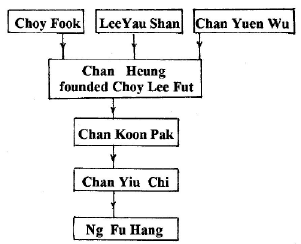
what has been passed down to me by our Sifu, Master Ng Fu Hang. This
account of the history is in reference to Master Ng Fu Hang's
lineage.
CHAN YUEN
WU
The founder of Choy Lee Fut is Chan
Heung. Chan Heung was from the village King Mui, in
the district of Ngi Sai, the county of Sun Wui, in the Kwuntung
province.
From the age of seven, Chan Heung was
taught martial arts by his uncle, Chan Yuen Wu. Although only a boy,
Chan Heung was strong and quick to learn. He had a natural ability
and quickly succeeded in gaining the affection of his uncle, who
spared no effort in
teaching him all that he knew. Within a few years Chan Heung’s kung
fu had made such remarkable progress that he was invited to set up
his own school for his uncle in the town of Sun Wui. As time passed,
and his reputation began to soar, he gained many students.
LEE YAU
SHAN
One day he discovered that another
instructor by the name of Lee Yau Shan had been invited to teach in
the neighbourhood. Lee was a disciple of the Shaolin monk Jin Sin,
and his skill was said to be formidable. Chan Heung, being strong
willed and a lover of a good fight, decided to test his skills. He
ambushed Lee as he was leaving a restaurant and tried to throw him
to the ground by putting both his arms around Lee’s waist. However,
Lee took the attack calmly, bent his knees slightly, and lowered his
chi and center of gravity in such a way that no matter how hard Chan
Heung tried, he could not make Lee budge. Lee then spun around,
lifted his foot to trip and kick at the same time, and threw him
yards away. Lee was rather curious about his assailant upon seeing
that Chan Heung was able to leap up uninjured after his fall. Lee
complimented Chan Heung, then demanded to know what school he
belonged to, and the reason for attacking him in such a sneaky
fashion rather than challenging him properly to a fight. Chan Heung
felt ashamed, and replied that the attack was his own idea in an
attempt to test the inadequacy of his own skill, and that he did not
want to implicate his teacher for his own defeat. Lee, amused at
this reply, left Chan Heung in his bewilderment.
Days later,
Chan Heung learned that Lee had remarked that someone as young and
strong as Chan Heung, with such intelligence and ability, was
wasting his life and talent because vanity prevented him from
improving his skill. Chan Heung then realized the truth, that there
was no limit to the art of kung fu, and he immediately resigned from
his post as Chief Instructor, enrolling in Lee's school instead.
Chan Heung was Lee's disciple for five years, and took his skill to
a new height.
CHOY
FOOK
One day, Lee
Yau Shan and Chan Heung heard of a recluse monk by the name of Choy
Fook, who was living in a temple on Mount Law Fou. This monk was
renown for his skill in Chinese medicine. Lee told Chan Heung that
if the monk was so skillful in dit da (treatment of muscular and
skeletal injuries), he must also be skillful in martial arts. Bitten
by the bug of curiosity, Lee and Chan decided to visit this monk
immediately.
On reaching the temple
gate, they encountered a man, old in years, yet tall and muscular
with a penetrating gaze. He claimed that he was a disciple of monk
Choy Fook and invited the two visitors to enter the temple and take
some tea with him while waiting for his teacher's return from his
daily rounds. While the two visitors were seated, the old man
proceeded to chop the wood to boil the water, doing so with his bare
hands. Lee's curiosity was aroused. He commented to Chan Heung that
this old mans kung fu was quite good, and that if he was showing off
for their benefit it meant they must reply with some of their own
tricks. Lee got up and walked to the side of a stone rice grinder
that was lying next to the temple steps. He first loosened the soil
around the stone slabs, then stood back and kicked the rice grinder
clean off the ground. The old man watched with amusement. He then
walked up to the rice grinder and chopped off a corner of the top
slab, pulverising it with his bare hands and throwing the powder in
front of Lee, announcing that he was indeed Choy Fook and that the
powder was a memento for intruders who did not behave in proper
manner.
Lee, filled with respect for Choy Fook, thanked the
old man and left immediately, leaving Chan Heung behind to deal with
the situation. Being a guileless young man devoted to martial arts,
Chan Heung realized that this was an opportunity to further his
training under another teacher of superior skill. He immediately
fell on his knees in front of the monk and begged Choy Fook to
accept him as a disciple. Choy Fook surveyed Chan Heung in silence -
taking in the young man's mannerisms - and finally concluded that
the request was a genuine one. He smiled and said to Chan Heung that
if he wished to be a disciple he must obey the following three
instructions or else he must leave immediately. These were the three
instructions that Choy Fook ordered Chan Heung to obey:
1. Chan Heung must stay with him in the
monastery for at least ten years until the end of his
apprenticeship;
2. Chan Heung was forbidden to use his
skills to kill or to maim, and must never be boastful of what he
attained;
3. Chan Heung must kick the rice grinder back into
its original resting place.
Much to Chan Heung's
delight the rice grinder fell back into its old hole easily, and he
became Choy Fook's disciple.
For the next ten years, Choy
Fook taught Chan Heung kung fu with great discipline and precision.
Each new technique took days to learn, and Chan Heung had to master
each new movement with speed, accuracy, power and understanding
before the next could be taught. Chan Heung found his kung fu
improved remarkably, and was very different to what it had been. The
knowledge passed down by Choy Fook, whether bare fist techniques,
the staff or wooden dummy training aids etc., was endless and full
of subtle changes, like nature itself. A combination of hard work,
dedication, natural ability, and the karma of a good teacher,
enabled Chan Heung to complete his training within the ten-year
period.
Choy Fook Bids Chan Heung
Farewell
One day Choy Fook hosted a banquet for Chan
Heung and proceeded to bid him farewell. During the festivities Choy
Fook told Chan Heung of his own origin. He was originally from
Fukien Shaolin monastery, which had been destroyed by fire. While he
was in Fukien, the Ching army invited 36 monks from his monastery to
help squash the rebellion in Tibet, which had been going on for
three years. It took three months to get Tibet under control again.
Fearing the martial prowess of the Shaolin monks, the Ching
government invited the monks to join the court as monk soldiers.
When the monks refused, the Ching government, fearing future
opposition, decided to eradicate the entire Shaolin monastic order
by putting the torch to the whole temple complex on the 25th day of
the 7th moon in the 11th year of the reign of Emperor Jung Jing
(approx. 1734). All save six monks perished; Choy Fook was one of
them and escaped with his head on fire. He was nicknamed 'rotten
head' because of the burn scar on his head. Later on he made his way
to Mount Law Fou in Kwangtung province where he went into hiding.
Choy Fook admonished Chan Heung that if one truly wanted to
follow the way of the Shaolin, it was necessary to seek the way of
the Buddha, as well as learning Chinese medicine and the 'six magic
spells'. Choy Fook continued to say that Shaolin fighting arts had
originated with the founder of the monastery, Monk Dart Mor
(Bodhidhama) and later on had been improved by Monk Gok Yuen and
others. Masters from outside the monastery had also been invited to
contribute their skills. These included the famous Lee Sau and Bak
Juk Fung. With time and constant experiment Shaolin fighting arts
were further refined. Six years of Shaolin kung fu practice could be
regarded as a small accomplishment; ten years could be regarded as a
qualified accomplishment. Choy Fook said that he was not quite sure
whether it was Chan Heung's good fortune or his (meaning Shaolin
martial arts) that Chan Heung had succeeded in learning all that he
could teach, since he was quite resigned to the fact that he might
die in this wilderness, taking his art with him to the grave.
Although he was quite willing to send Chan Heung home, Choy Fook
continued to say that to be a true follower of Shaolin, one must
also seek the way of the Buddha as well as learning the 'six magic
spells'. Hearing that, Chan Heung decided to stay for an extra two
years until he was ready to leave the monastery in the twelfth year.
At the time of his farewell, Chan Heung asked his teacher to
spell out his future. Choy Fook told him that although he was not
meant for the life of a court official (by sitting the martial
examination), he and his offspring would be leaders of men as long
as the Shaolin tradition was kept alive.
Amongst other
advice given, Choy Fook gave Chan Heung a double couplet which time
has proven to be authentic:
"The dragon
and the tiger met in heaven, to revive our Shaolin ways"
"Teach your followers righteousness, let each generation
uphold and enliven"
When Chan Heung bid his final
farewell, he was accompanied by three of his brothers in learning
all the way down the mountain slope. They were Jeung Tin Cheung
(nicknamed Courageous Jeung), a monk from Mount Law Fou by the name
of Tung Kwan, and a man from his own Sun Wui county called Chan
Chung Nin.
Chan Heung Returns to the Sun
Wui County
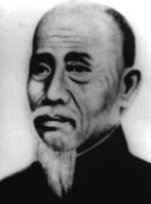
Chan Heung returned to his village and set up a
clinic to treat the sick and help the poor. Later he was persuaded
by the elders of the family to set up a school in the village
ancestral hall. He called the place Hung Sing Gwoon (Great Sage
School) and his clinic Wing Sing Tong (Hall of Eternal Victory). At
the time he reasoned that all the major branches of Chinese martial
arts originated from the Shaolin temple, such as famous styles under
the family names of Hung, Lau, Choy, Lee, and Mok. Seeing that his
brand of kung fu was also taught by the teachers with the surnames
of Choy, Lee and Chan, he thought it would be right to synthesize
their teachings and give it a name that would commemorate and honor
their deeds, instead of selfishly calling it the Chan style. He
chose the name Choy Lee Fut, giving the explanation: Choy in the
honor of monk Choy Fook, who gave him much of his knowledge; Lee, in
honor of Lee Yau San, and at the same time commemorate other
pioneers such as Lee Sau, who came and expanded and improved the
range of Shaolin martial arts; and Fut, meaning Buddha, to
commemorate the Buddhist origins of the art, since all his three
mentors could trace their lineage back to the Shaolin temple.
Chan
Heung Documents His Teachings
Three years later, at
the invitation of his uncle and the local overseas Chinese
association, Chan Heung left his village for the Northern Ocean
(believed to be America). There he taught the overseas Chinese for
three years, followed by three years in Hong Kong to teach his local
country compatriots. He then travelled to the Southern Ocean
(Malaysia and Singapore) to teach in the Kwangtung Association for
several years. Upon his return to Mount Law Fou to visit Choy Fook
he discovered that the monk had died during his absence at the age
of one hundred and twelve. Interpreting that fact that he had not
been able see his teacher one more time before his death as a
meaningful sign, he chose to do penance by undertaking the task of
editing all his learning into one book in order that there would be
a written record for posterity, and thus preventing the possibility
of misinterpretation and ambiguity creeping into the art. He named
the manuscript 'The Manual of Choy Lee Fut Fighting Arts'.
Chan Heung died on August 20, 1875.
Peacefully, he was buried in King Mui Village and remembered by all
of his followers since.
Chan Heung's
Offspring
Chan Heung had two sons,
On Pak and Koon Pak. Chan Koon Pak also had two sons, Man Bun and
Yiu Chi. Chan Yiu Chi had two sons, Wan Hon (Master Chen Yong Fa's
father) and Sun Chu, and a daughter, Kit Fong (Master Ng Fu Hang's
Mother).
CHAN KOON PAK - The
Successor to Chan Heung
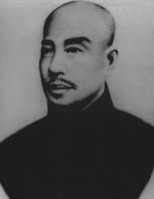
Chan Koon Pak, the second
son of Chan Heung, was a very adept and intelligent person. At a
rather young age, he had mastered the art his father had passed onto
him, but Chan Koon Pak chose to become a merchant and settled in
Kong Moon. Under persistent persuasion, he did come out for a
stint as the head instructor of the Choy Lee Fut school in Kong
Moon. Chan Koon Pak later moved to Canton, where he opened a kung fu
school as a result of popular request. Countless number of people
had come to him for instructions; notably Ngan Yiu Ting, Wong Fook
Wing, Wu Kee Biu, Lee Hin Cheung, Choy Pak Tat, Choy Pak Hung,
etc.
Chan Koon Pak died on January 28,
1916.
CHAN YIU CHI - The Past
Grandmaster
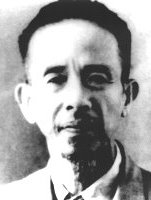
Chan Koon Pak was a
disciplinarian and the same stern attitude to learning was also
impressed onto his son Yiu Chi. Chan Yiu Chi seldom turned his
thoughts off kung fu. Even when sitting idle, his feet could be seen
practicing. This kind of incessant work made Chan Yiu Chi an
outstanding exponent of Choy Lee Fut. He represented speed, power,
agility and more. Perhaps less known to many people, Chan Yiu Chi
was also a classical scholar, and he never bragged about or showed
off his deadly kung fu skill. At the time of his staying with his
father, Chan Koon Pak in Canton, he engaged in the propagation of
Choy Lee Fut to the world at large. Requests were received
regularly, asking him to teach abroad in San Francisco, Holland, the
South Pacific and other overseas countries where there were
substantial Chinese population. As Chan Koon Pak was in an advanced
age, Yiu Chi did accept, as his father so desired, several posts as
kung fu instructor in many secondary and tertiary schools, trade
unions, sports clubs, and worker's associations. His prominence in
kung fu overshadowed his other fields of excellence - that of poetry
and classics.
Chan Yiu Chi was a fair and just man. He
held no secret about the kung fu he was well known for. Any question
was answered in detail and he analyzed kung fu objectively as a
scholar of his standing would. Students showing potential were also
taught Chinese medicine, as he was also a practitioner of
traditional Chinese medicine. It is worth noting that as a
practitioner of medicine, he never refused consultation and only
charged what the patients could afford to pay.
According to Master Ng Fu Hang, Chan Yiu
Chi was responsible for officially organizing the entire system of
Choy Lee Fut. He recorded every form by carefully writing down their
movements and its applications (these forms were recorded into what
is referred to as "Kuen Po's" - Fist Manuals). These
records remain safely guarded by the Chan
Family.
Chan Yiu Chi died on July 5, 1965. His
deeds are still fondly remembered with
affection.
NG FU HANG - Grandson of
Chan Yiu Chi
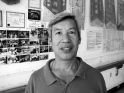
Chan Yiu Chi had two sons,
and a daughter, Chan Kit Fong. Chan Kit Fong, who is also a highly
regarded and respected practitioner of Choy Lee Fut, had a son,
Ng Fu Hang.
Ng Fu Hang started his kung fu training
at the age of six with his grandfather, Chan Yiu Chi. He would start
practising as early as 6 a.m.. When Ng Fu Hang was old enough to
work, he would train early in the morning, go to work all day, and
then return to help his grandfather teach. Ng Fu Hang continued his
training under his grandfather's watchful eyes until Chan
Yiu Chi passed away in 1965.
In 1970, Ng Fu Hang was invited by his
uncle (kung fu uncle), Chan Yiu Wun, to help him set up his new
school in Hong Kong and help teach. He accepted the offer and
remained there for several years. In 1976, Ng Fu Hang decided to
move to America with his mother, Chan Kit Fong, and settled in Los
Angeles, California. Ng Fu Hang was going to leave his kung fu in
Hong Kong and concentrate on making a living and a new life for him
and his mother.
Everything changed in 1992, when Ng Fu
Hang's family convinced him to begin teaching and spreading the
family style of Choy Lee Fut in America. Ng Fu Hang began
instructing a select group of students in his backyard/driveway
right outside China Town in Los Angeles, California. Several years
later, in 1998, he opened a school in Arcadia, California, and
still teaches with the same tradition and integrity as his
grandfather, Chan Yiu Chi.
Ng Fu Hang is now the head of the Chan
Family Style of Choy Lee Fut in America, and his goal is
to help propagate Choy Lee Fut here, and abroad.
return to top of the
page
|















